What Donor Visibility Actually Means, and Why Most NGOs Get It Wrong
By Nelson Asoh | Communications for Development
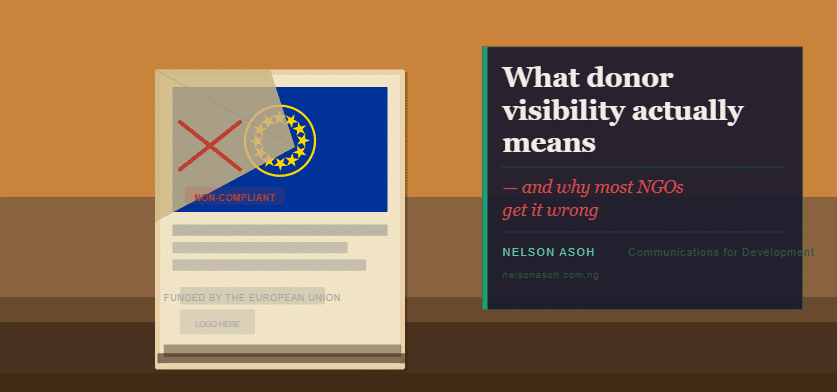
There is a poster I have seen many times in programme offices across Northeast Nigeria. It is well-designed. The photographs are strong. The messaging is clear. But in the bottom corner, where the donor logo should sit, there is a generic flag icon that looks nothing like the European Union emblem. The font is wrong. The minimum size requirement has been ignored. The tagline appears in a colour that makes it nearly invisible against the background.
The programme team worked hard on that poster. But as far as the donor’s visibility requirements are concerned, it does not exist.
That is the gap between what most NGOs think donor visibility means and what it actually means.
The Misunderstanding Most NGOs Have About Donor Visibility
The Misunderstanding
Ask most programme staff and they will tell you: put the donor logo on your materials. That is not wrong. But it is about ten per cent of the answer.
Donor visibility is a contractual, strategic, and reputational obligation. It is how donors demonstrate to their own taxpayers and parliaments that their money is being used and producing results. When the EU funds a conflict mitigation programme in Adamawa State, it is funding a public record of European investment in Nigerian development. That record must be visible, accurate, and consistent, or the programme has failed a core deliverable, regardless of what happened in the field.
What Getting Donor Visibility Right Actually Looks Like
Getting It Right
Good donor visibility means planning from Day One, using approved brand assets, keeping a distribution record for every material produced, and writing stories that centre human change rather than programme activity.
It is not complicated. But it requires someone who takes it seriously from the beginning.
What Donor Visibility Actually Covers
Donor visibility is a system, not a checklist item. Here is what it actually comprises in a well-run programme.
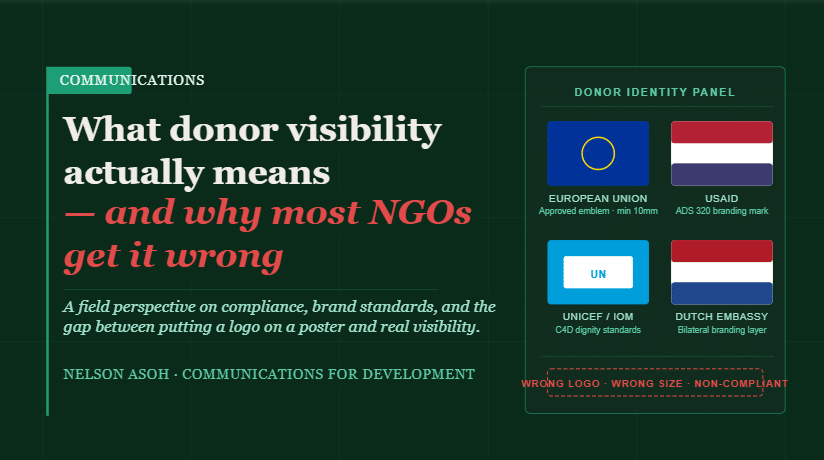
Approved brand assets. Every donor has a logo kit with specific rules about size, colour, placement, and co-branding. The EU’s visual identity guide runs to dozens of pages. USAID has branding and marking requirements embedded in every contract. Using the wrong logo, the wrong colour version, or placing it below minimum size requirements counts as a compliance failure, even if your materials are otherwise excellent.
A visibility plan. This is a document, agreed with the donor at programme inception, that maps out what materials will be produced, where they will be displayed, and how their reach will be measured. Without one, you are producing visibility materials with no strategic logic behind them.
A distribution record. Every item produced under donor funding needs to be tracked: how many were printed, where they went, who received them, and when. This documentation is what you present at mid-term reviews and final evaluations when asked to demonstrate compliance.
Impact stories. Donors do not just want proof that their logo appeared on a banner. They want evidence that the programme changed lives. A story that shows a named individual, with consent, whose situation improved because of donor-funded activities is worth more to a donor’s communications team than a hundred posters. It is the content they use to report back to their own parliaments and publics.
Digital visibility. Social media posts that mention programme activities must acknowledge the donor correctly, using the right handle, the right hashtag, and the right co-branding language. This applies to your organisation’s accounts, your partners’ accounts, and any community accounts that are part of the programme’s communication ecosystem.
The Most Common Mistakes I See
After more than fifteen years of communications work across programmes funded by the EU, USAID, UNICEF, IOM, and the Dutch Embassy, I have seen the same mistakes repeated across organisations of every size.
The first is downloading a logo from the internet instead of requesting the approved asset pack from the donor. Internet versions are often low resolution, out of date, or the wrong colour variant. Approved asset packs come with usage guidelines attached.
The second is treating visibility as a reporting task rather than a programme task. Teams that only think about visibility when a report is due will always be scrambling. The materials that should have been photographed, the consent forms that should have been signed, the stories that should have been documented during implementation are no longer available.
The third is ignoring the narrative requirement. Placing a logo on a material satisfies one line of the visibility obligation. Writing a story that shows what changed in a beneficiary’s life because of the funded programme satisfies the donor’s deeper need, which is to demonstrate value to their own constituents.
A Practical Starting Point
If you are managing a donor-funded programme right now, here is where to start. Request the official brand asset pack from your programme officer if you do not already have it. Read the visibility and marking requirements section of your contract, not just the activities and budget sections. Appoint someone, even if it is a part-time responsibility, to own visibility compliance from inception to closeout. And build story collection into your field team’s routine, so that by the time your first report is due, you already have material to work with.
Donor visibility done well is not a burden. It is evidence. And evidence is what keeps funding flowing.
If you want to go deeper on how to write the impact stories that sit at the heart of good donor visibility, read How to Tell a Beneficiary Story Without Exploiting Them. And if your communications team is still being brought in at the end of programme cycles rather than at the beginning, Why NGO Communication Teams Must Stop Thinking Like Support Departments is worth reading alongside this.
Nelson Asoh is a Communications Coordinator at Search for Common Ground Nigeria with over 15 years of experience in strategic communications, donor visibility, and digital engagement across peacebuilding, humanitarian, and development programmes funded by the EU, USAID, UNICEF, IOM, and the Dutch Embassy.
Nelson Asoh has 15+ years of experience in NGO and INGO communications, working with programmes funded by UNICEF, the EU, USAID, IOM and the Dutch Embassy. Visit nelsonasoh.com.ng or take the free Communications Health Check.